Description
Who Should Attend
This course is designed for professionals responsible for software engineering practices and development workflows.
Typical attendees include:
• Senior software engineers
• Technical leads
• Software architects
• Engineering managers
• Principal developers
The course is particularly valuable for teams that have already begun experimenting with AI-assisted development and want to introduce AI in a structured and responsible way across engineering teams.
Prerequisites
Participants should have a background in software development and engineering practices.
It is recommended that participants either:
• have experience using AI tools in development environments, or
• have attended the AI-Assisted Software Engineering for Developers course.
Learning Objectives
By the end of the course participants will understand how to:
• integrate AI tools into software engineering workflows
• scale AI-assisted development practices across teams
• maintain code quality and architectural standards when using AI-generated code
• review and validate AI-assisted development at scale
• apply governance and security practices for AI-assisted development
• introduce AI responsibly into production development environments
Course Content
AI Adoption at Engineering Team Scale
• common patterns of AI adoption in development teams
• challenges of scaling AI usage across engineering groups
• balancing productivity with engineering discipline
Designing Engineering Workflows with AI
• AI within the software development lifecycle
• defining responsible AI usage within development teams
• integrating AI tools into engineering practices
Reviewing AI-Generated Code
• approaches to reviewing AI-generated changes
• identifying risks in generated code
• maintaining developer accountability
Architecture and Security Considerations
• architectural oversight in AI-assisted development
• security considerations when using AI-generated code
• protecting intellectual property and sensitive codebases
AI in CI/CD Pipelines
• integrating AI into development pipelines
• AI-assisted testing and validation
• automation opportunities within CI/CD workflows
Managing Software Quality
• maintaining code maintainability and readability
• preventing AI-generated technical debt
• balancing productivity with long-term engineering quality
AI-Assisted Testing Strategies
• using AI to generate tests
• validating AI-generated test cases
• improving software quality through AI-assisted testing
Building AI-Capable Engineering Teams
• defining best practices for AI-assisted development
• evolving engineering roles and responsibilities
• introducing AI capabilities across development teams
Practical Exercises
Throughout the course participants will explore:
• examples of AI-generated code and development workflows
• engineering scenarios involving AI-assisted development
• approaches to integrating AI tools into development practices
The sessions include interactive discussion and practical exercises focused on real software engineering scenarios.
Duration
2 Days
Delivered as live instructor-led training, either:
• virtually
• or privately for engineering teams
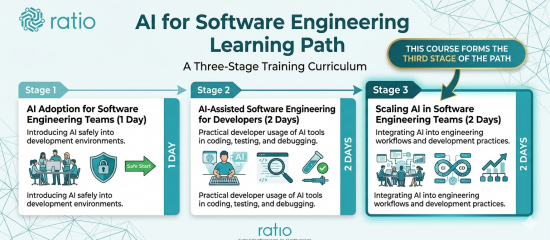
Part of the AI for Software Engineering Teams Learning Path
This course forms the third stage of the AI for Software Engineering Teams learning path.
1. AI Adoption for Software Engineering Teams (1 Day)
Introducing AI safely into development environments.
2. AI-Assisted Software Engineering for Developers (2 Days)
Practical developer usage of AI tools in coding, testing, and debugging.
3. Scaling AI in Software Engineering Teams (2 Days)
Integrating AI into engineering workflows and development practices.

Senior Software Architect & Development Instructor
Microsoft MVP | 30+ Years Engineering Experience
This course is presented by Peter
Peter brings more than 30 years of experience in software architecture, development, and technical training, helping engineering teams design, modernise, and improve complex systems across enterprise, cloud, embedded, and data-driven environments.
He has been exploring the role of AI in software engineering since the early wave of modern AI tooling, focusing on how development teams can use AI productively while maintaining strong engineering standards, governance, and architectural discipline.
Alongside his engineering background, Peter has a Master’s level background in Mathematics and is currently working towards a PhD, bringing deep analytical insight into how AI systems behave and how engineers should evaluate and integrate them responsibly.