Description
Course Overview
AI tools are now appearing in many development environments and engineering teams are beginning to explore how they can improve productivity across software development activities.
However, introducing AI into development workflows raises important questions around engineering standards, security, governance and responsible use.
This workshop introduces engineering teams to the practical considerations involved in adopting AI within software development environments. Participants explore where AI tools can support engineering work and how teams can introduce these technologies while maintaining software quality and engineering discipline.
Understanding AI in Software Engineering
The course begins by exploring how AI tools are influencing modern software development.
Topics include:
• what AI coding tools can do
• where AI can improve developer productivity
• limitations of AI-generated output
• understanding when human engineering judgement is required.
Identifying Opportunities for AI in Development Teams
Participants explore where AI tools can support software engineering tasks, including:
• code generation and assistance
• debugging and analysis
• documentation creation
• test case generation
• supporting development workflows.
The session helps teams identify practical use cases where AI tools may support engineering work.
Engineering Standards and Governance
Introducing AI tools requires clear engineering practices and governance.
Topics include:
• reviewing AI-generated code
• maintaining coding standards
• managing security considerations
• protecting intellectual property
• defining responsible AI usage within engineering teams.
Introducing AI into Development Workflows
The course explores how organisations can introduce AI tools into their engineering environments.
Topics include:
• evaluating AI tools
• running pilot projects
• defining team guidelines for AI usage
• integrating AI tools into existing development practices.
Practical Discussion and Adoption Planning
The workshop concludes with a discussion around how engineering teams can approach AI adoption in a structured and responsible way.
Participants explore:
• common challenges when introducing AI tools
• defining internal policies
• building confidence within engineering teams.
Who Should Attend
This course is designed for engineering teams exploring the use of AI within software development environments.
Typical participants include:
• software engineers
• development team leads
• engineering managers
• technical architects.
Requirements
Participants should have experience with software development and engineering workflows.
No prior experience with AI tools is required.
Instructor Experience
This course is delivered by experienced software engineering professionals who work directly with development teams exploring the practical use of AI tools within software engineering environments.
The instructors combine software development expertise with practical experience of introducing AI-assisted workflows within engineering teams. The training focuses on real development scenarios and provides practical guidance on how organisations can adopt AI tools while maintaining engineering standards, security and governance.
Participants benefit from practical insights into how AI tools can support developer productivity while ensuring that software quality and engineering discipline are preserved.
Also Available as Private Team Training
This course is also available as private training for engineering teams and organisations.
Private delivery allows the workshop to focus on the development environments, programming languages and engineering practices used within your organisation. The training can also explore how AI tools may integrate with existing development workflows and internal governance policies.
This format works particularly well for organisations introducing AI tools across development teams who want engineers to explore the technology together.
Private training is available for teams of four or more engineers and can be delivered virtually or onsite.
Client Feedback
Feedback from engineers attending our software engineering and AI training highlights the practical and balanced approach taken in the workshops.
Participants particularly value the focus on real development workflows and the discussion around responsible adoption of AI tools within engineering teams.
Typical feedback from attendees includes:
• “Very useful overview of how AI tools can support development teams.”
• “Good balance between productivity improvements and engineering governance.”
• “Helpful discussion around introducing AI into real development environments.”
• “Clear explanation of where AI tools are useful and where engineering judgement is still essential.”
Our courses are designed to combine practical engineering experience with structured learning, helping teams understand how new technologies can be introduced responsibly within software development environments.
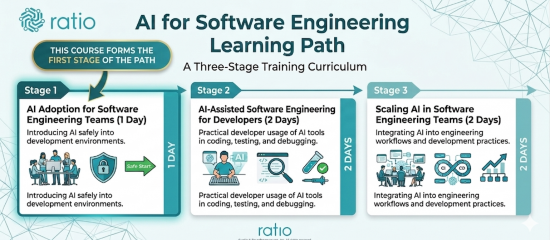
Part of the AI for Software Engineering Teams Learning Path
This course forms the third stage of the AI for Software Engineering Teams learning path.
1. AI Adoption for Software Engineering Teams (1 Day)
Introducing AI safely into development environments.
2. AI-Assisted Software Engineering for Developers (2 Days)
Practical developer usage of AI tools in coding, testing, and debugging.
3. Scaling AI in Software Engineering Teams (2 Days)
Integrating AI into engineering workflows and development practices.

Senior Software Architect & Development Instructor
Microsoft MVP | 30+ Years Engineering Experience
This course is presented by Peter
Peter brings more than 30 years of experience in software architecture, development, and technical training, helping engineering teams design, modernise, and improve complex systems across enterprise, cloud, embedded, and data-driven environments.
He has been exploring the role of AI in software engineering since the early wave of modern AI tooling, focusing on how development teams can use AI productively while maintaining strong engineering standards, governance, and architectural discipline.
Alongside his engineering background, Peter has a Master’s level background in Mathematics and is currently working towards a PhD, bringing deep analytical insight into how AI systems behave and how engineers should evaluate and integrate them responsibly.