Description
Course Overview
AI coding tools are now appearing in almost every development team. Tools such as GitHub Copilot and other AI assistants can significantly accelerate coding tasks, generate boilerplate code and assist with testing and documentation.
However, introducing AI into software development also raises important questions around engineering standards, code quality, security and governance.
This course explores how development teams can use AI tools effectively while maintaining the practices required to produce reliable and maintainable software systems.
Participants learn how AI assistants fit within modern development workflows and how engineering teams can apply governance and review processes when using AI-generated code.
Practical AI-Assisted Development
During the workshop participants explore practical scenarios where AI tools can support software engineering tasks including:
• generating code structures
• refactoring existing code
• debugging and problem analysis
• generating test cases
• improving documentation
The course also explores how development teams can integrate AI tools into existing development practices without compromising software quality.
Course Topics
Introduction to AI-Assisted Development
• how AI coding tools work
• capabilities and limitations
• common development use cases
• risks and misconceptions.
AI Tools in the Development Workflow
• using AI for code generation
• AI-assisted debugging
• generating unit tests
• documentation and developer productivity.
Engineering Standards and Code Quality
• reviewing AI-generated code
• ensuring maintainability
• avoiding technical debt
• aligning AI tools with development standards.
Governance and Responsible AI Use
• introducing AI tools within engineering teams
• security considerations
• protecting intellectual property
• governance policies for AI-assisted development.
Practical Development Exercises
Participants explore real examples of AI-assisted coding workflows and discuss how teams can integrate these tools into existing development environments.
Who Should Attend
This course is designed for developers and engineering teams exploring the use of AI tools within software development.
Typical participants include:
• software developers
• software engineers
• technical leads
• engineering teams adopting AI coding tools.
Requirements
Participants should have experience with software development and programming concepts.
Familiarity with common development environments and version control systems such as Git is helpful.
No previous experience with AI tools is required.
Instructor Experience
The course is delivered by experienced software engineering practitioners who have worked with development teams adopting AI-assisted workflows.
The instructors focus on practical engineering considerations, helping participants understand how AI tools can be introduced while maintaining professional software development practices.
Private Team Training
This course is also available as private training for development teams.
Private delivery allows the workshop to focus on the development tools, programming languages and workflows used within your organisation.
Private training is available for teams of four or more developers and can be delivered virtually or onsite.
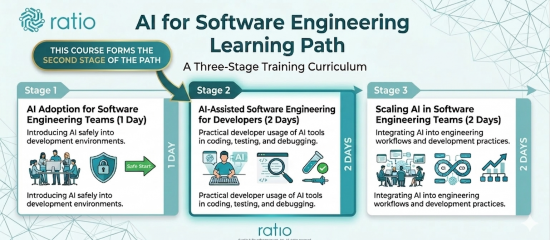
Part of the AI for Software Engineering Teams Learning Path
This course forms the third stage of the AI for Software Engineering Teams learning path.
1. AI Adoption for Software Engineering Teams (1 Day)
Introducing AI safely into development environments.
2. AI-Assisted Software Engineering for Developers (2 Days)
Practical developer usage of AI tools in coding, testing, and debugging.
3. Scaling AI in Software Engineering Teams (2 Days)
Integrating AI into engineering workflows and development practices.

Senior Software Architect & Development Instructor
Microsoft MVP | 30+ Years Engineering Experience
This course is presented by Peter
Peter brings more than 30 years of experience in software architecture, development, and technical training, helping engineering teams design, modernise, and improve complex systems across enterprise, cloud, embedded, and data-driven environments.
He has been exploring the role of AI in software engineering since the early wave of modern AI tooling, focusing on how development teams can use AI productively while maintaining strong engineering standards, governance, and architectural discipline.
Alongside his engineering background, Peter has a Master’s level background in Mathematics and is currently working towards a PhD, bringing deep analytical insight into how AI systems behave and how engineers should evaluate and integrate them responsibly.